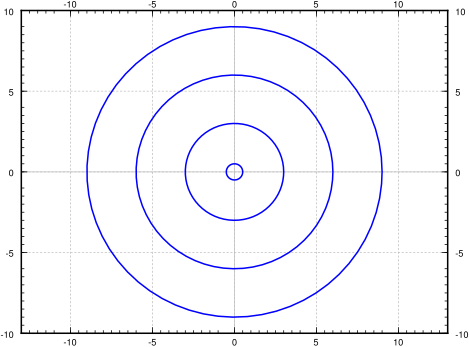
A type of equation that comes up quite often in physics and engineering is an exact equation. Suppose \(F(x,y)\) is a function of two variables, which we call the potential function. The naming should suggest potential energy, or electric potential. Exact equations and potential functions appear when there is a conservation law at play, such as conservation of energy. Let us make up a simple example. Consider
If we apply the total derivative to the equation \(F(x,y) = C\text{,}\) we find the differential equation \(dF = 0\text{.}\) This differential equation has the form
\begin{equation}
M \, dx + N \, dy = 0, \qquad
\text{or} \qquad
M + N \, \frac{dy}{dx} = 0 .
\end{equation}
An equation of this form is called exact if it was obtained as \(dF = 0\) for some potential function \(F\text{.}\) In our simple example, we obtain the equation
Since we obtained this equation by differentiating \(x^2+y^2=C\text{,}\) the equation is exact. We often wish to solve for \(y\) in terms of \(x\text{.}\) In our example,
\begin{equation}
y = \pm \sqrt{C-x^2} .
\end{equation}
In terms of multivariable calculus, at each point \((x,y)\) in the plane, \(\vec{v} = (M,N)\) is a vector, that is, a direction and a magnitude. As \(M\) and \(N\) are functions of \((x,y)\text{,}\) we have a vector field. A vector field \(\vec{v}\) that comes from an exact equation is a so-called conservative vector field, that is, a vector field that comes with a potential function \(F(x,y)\text{,}\) such that
Let \(\gamma\) be a path in the plane starting at \((x_1,y_1)\) and ending at \((x_2,y_2)\text{.}\) If we think of \(\vec{v}\) as force, then the work required to move along \(\gamma\) is the path integral
\begin{equation}
\int_\gamma \vec{v}(\vec{r}) \cdot d\vec{r}
=
\int_\gamma M \, dx + N \, dy
=
F(x_2,y_2) - F(x_1,y_1) .
\end{equation}
In other words, the work done depends only on the endpoints—where we start and where we end. For example, suppose \(F\) is gravitational potential (physicists use the convention that \(-F\) is the potential, but the idea is the same). The derivative of \(F\) given by \(\vec{v}\) is the gravitational force. What we are saying is that the work required to move a heavy box from the ground floor to the roof only depends on the change in potential energy. The work done is the same no matter what path we took; if we took the stairs or the elevator. Although if we took the elevator, the elevator did the work for us. Movement along the curves \(F(x,y) = C\) requires no work done, such as the heavy box sliding along without accelerating or braking on a perfectly flat roof on a cart with incredibly well-oiled wheels.
Now you, the reader, should ask: Where did we solve a differential equation? Well, in applications we generally know \(M\) and \(N\text{,}\) but we do not know \(F\text{.}\) That is, we may have just started with \(2x + 2y \frac{dy}{dx} = 0\text{,}\) or perhaps even
\begin{equation}
x + y \frac{dy}{dx} = 0 .
\end{equation}
It is up to us to find some potential \(F\) that works. Many different \(F\) will work; adding a constant to \(F\) does not change the equation. Once we have a potential function \(F\text{,}\) the equation \(F\bigl(x,y(x)\bigr) = C\) gives an implicit solution of the ODE.
If we know that this is an exact equation, we start looking for a potential function \(F\text{.}\) We have \(M = 2x\) and \(N=2y\text{.}\) If \(F\) exists, it must be such that \(F_x (x,y) = 2x\text{.}\) Integrate in the \(x\) variable to find
for some function \(A(y)\text{.}\) The function \(A\) is the “constant of integration,” though it is only constant as far as \(x\) is concerned, and may still depend on \(y\text{.}\) Now differentiate (1.5) in \(y\) and set it equal to \(N\text{,}\) which is what \(F_y\) is supposed to be:
Integrating, we find \(A(y) = y^2\text{.}\) We could add a constant of integration if we wanted to, but there is no need. We found \(F(x,y) = x^2+y^2\text{.}\) Next for a constant \(C\text{,}\) we solve
\begin{equation}
F\bigl(x,y(x)\bigr) = C
\end{equation}
for \(y\) in terms of \(x\text{.}\) In this case, we obtain \(y = \pm \sqrt{C-x^2}\) as we did before.
Why did we not need to add a constant of integration when integrating \(A'(y)
= 2y\text{?}\) Add a constant of integration, say \(3\text{,}\) and see what \(F\) you get. What is the difference from what we got above, and why does it not matter?
But there is no way to satisfy this requirement! The function \(xy\) cannot be written as \(x\) plus a function of \(y\text{.}\) The equation is not exact; no potential function \(F\) exists.
Is there an easier way to check for exactness, other than failing in trying to find \(F\text{?}\) Yes there is. Suppose \(M = F_x\) and \(N = F_y\text{.}\) As long as the second derivatives are continuous,
If \(M_y \neq N_x\text{,}\) the equation is not exact. For example, in Example 1.8.2, where \(M = 2x + y\) and \(N = xy\text{,}\) the equation is not exact. Indeed, \(M_y = 1\) and \(N_x = y\) are not equal.
What is interesting is that this idea works in reverse too. If \(M_y=N_x\text{,}\) then a potential exists, at least near an initial point. This result is called the Poincaré Lemma 2
If \(M\) and \(N\) are continuously differentiable functions of \((x,y)\text{,}\) and \(\frac{\partial M}{\partial y} = \frac{\partial N}{\partial x}\text{,}\) then near any point there is a function \(F(x,y)\) such that \(M = \frac{\partial F}{\partial x}\) and \(N = \frac{\partial F}{\partial y}\text{.}\)
Differentiating in \(y\) and setting to \(N\text{,}\) we find
\begin{equation}
x-1 = x + A'(y) .
\end{equation}
So \(A'(y) = -1\text{,}\) and \(A(y) = -y\) will work. We obtain \(F(x,y) = x^2+xy-y\text{,}\) so the implicit solution is \(x^2+xy-y = C\text{.}\) First we find \(C\text{.}\) As \(y(0)=1\text{,}\) we have \(F(0,1) = C\text{.}\) Therefore, \(0^2+0\times 1 - 1 = C\text{,}\) so \(C=-1\text{.}\) Now we solve \(x^2+xy-y = -1\) for \(y\) to get
\begin{equation}
y = \frac{-x^2-1}{x-1} .
\end{equation}
This vector field \((M,N)\) is not conservative (the equation is not exact) if considered as a vector field of the entire plane minus the origin. The problem is that if the curve \(\gamma\) is a circle around the origin, say starting at \((1,0)\) and ending at \((1,0)\) going counterclockwise, then if \(F\) existed, we would expect
That is nonsense! We leave the computation of the path integral to the interested reader, or you can consult your multivariable calculus textbook. So there is no potential function \(F\) defined everywhere outside the origin \((0,0)\text{.}\)
The Poincaré Lemma does not guarantee such an \(F\) anyway. It only guarantees a potential function \(F\) locally—only in some region containing the initial point. As \(y(1) = 2\text{,}\) we start at the point \((1,2)\text{.}\) Considering \(x > 0\) and integrating \(M\) in \(x\) or \(N\) in \(y\text{,}\) we find
This \(F\) is defined on the region \(x > 0\) and so the equation is exact on that region. The implicit solution is \(\arctan \bigl( \nicefrac{y}{x} \bigr) = C\text{.}\) Solving, \(y = \tan(C) x\text{.}\) That is, the solution is a straight line. Solving \(y(1) =
2\) gives us that \(\tan(C) = 2\text{,}\) and so \(y= 2x\) is the desired solution. See Figure 1.19, and note again that the solution only exists for \(x > 0\text{.}\)
If the region where \(M\) and \(N\) are defined and where \(M_y=N_x\) has “no holes,” such as, for instance, the entire \(xy\)-plane, then the equation is exact and an \(F\) defined on that region can be found. For example, in Example 1.8.3, \(M=2x+y\) and \(N=x-1\) are defined in the entire plane and \(M_y = 1 = N_x\text{,}\) so a global \(F\) exists there. Similarly, in Example 1.8.4 the half-plane where \(x > 0\) also has “no holes” and a potential function exists on that region. So in such cases, checking \(M_y = N_x\) is good enough to check for exactness.
Therefore \(A'(y) = 2y\) or \(A(y) = y^2\) and \(F(x,y) = \frac{1}{3}x^3 + xy^2 +
y^2\text{.}\) We try to solve \(F(x,y) = C\text{.}\) We easily solve for \(y^2\) and then just take the square root:
When \(x=-1\text{,}\) the term in front of \(\frac{dy}{dx}\) is zero, and our explicit solution is not valid. The given equation has no solution (for \(y(x)\)) near \(x=-1\text{,}\) but the equation \((x^2+y^2) \, dx + 2y(x+1) \, dy = 0\) does have a solution \(x=-1\text{.}\) In fact, one could solve for \(x\) in terms of \(y\) for any initial condition. The solution is messy, so we leave it as \(\frac{1}{3}x^3 + xy^2 + y^2 = C\text{.}\)
Sometimes an equation \(M\, dx + N \, dy = 0\) is not exact, but it can be made exact by multiplying with a function \(u(x,y)\text{.}\) That is, perhaps for some nonzero function \(u(x,y)\text{,}\)
\begin{equation}
\frac{dy}{dx} + p(x) y = f(x), \qquad
\text{or} \qquad
\bigl( p(x) y - f(x) \bigr)\, dx + dy = 0,
\end{equation}
is always such an equation. Let \(r(x) = e^{\int p(x)\,dx}\) be the integrating factor for the linear equation. Multiply the equation by \(r(x)\) and write it in the form of \(M + N \frac{dy}{dx} = 0\text{.}\)
Then \(M = r(x) p(x) y - r(x) f(x)\text{,}\) so \(M_y = r(x) p(x)\text{,}\) while \(N = r(x)\text{,}\) so \(N_x = r'(x) = r(x) p(x)\text{.}\) In other words, we have an exact equation. Integrating factors for linear functions are just a special case of integrating factors for exact equations.
But how do we find the integrating factor \(u\text{?}\) Well, for \(uM \, dx + uN \, dy = 0\) to be exact, the function \(u\) should satisfy
\begin{equation}
\frac{\partial}{\partial y} \bigl[ u M \bigr] =
u_y M + u M_y =
\frac{\partial}{\partial x} \bigl[ u N \bigr] =
u_x N + u N_x .
\end{equation}
Therefore,
\begin{equation}
(M_y-N_x)u = u_x N - u_y M .
\end{equation}
At first it may seem we replaced one differential equation by another. Even worse, the new equation is a PDE. True, but all hope is not lost.
A strategy that often works is to look for a \(u\) that is a function of \(x\) alone, or a function of \(y\) alone. After all, that is what worked for linear equations. If \(u\) is a function of \(x\) alone, that is, \(u(x)\text{,}\) then we write \(u'(x)\) instead of \(u_x\text{,}\) and \(u_y\) is just zero. Then
In particular, \(\frac{M_y-N_x}{N}\) ought to be a function of \(x\) alone (not depend on \(y\)). If so, then we have a linear equation
\begin{equation}
u' - \frac{M_y-N_x}{N} u = 0 .
\end{equation}
Letting \(P(x) = \frac{M_y-N_x}{N}\text{,}\) we solve the linear equation to find \(u(x) = C e^{\int P(x) \, dx}\text{.}\) The constant in the solution is not relevant, we need any nonzero solution, so we take \(C=1\text{.}\) Then \(u(x) = e^{\int P(x) \, dx}\) is the integrating factor making the equation exact.
Similarly, we could try a function of the form \(u(y)\text{.}\) Then
\begin{equation}
\frac{M_y-N_x}{M} u = - u' .
\end{equation}
In particular, \(\frac{M_y-N_x}{M}\) ought to be a function of \(y\) alone. If so, we have a linear equation
\begin{equation}
u' + \frac{M_y-N_x}{M} u = 0 .
\end{equation}
Letting \(Q(y) = \frac{M_y-N_x}{M}\text{,}\) we find \(u(y) = C e^{-\int Q(y) \, dy}\text{.}\) We take \(C=1\text{.}\) So \(u(y) = e^{-\int Q(y) \, dy}\) is the integrating factor.
Consequently, \(A'(y) = \nicefrac{1}{y}\) or \(A(y) = \ln \, \lvert y \rvert\text{.}\) Thus \(F(x,y)
= xy + \ln \, \lvert y \rvert\text{.}\) It is not possible to solve \(F(x,y)=C\) for \(y\) in terms of elementary functions, so let us be content with the implicit solution:
\begin{equation}
xy + \ln \, \lvert y \rvert = C .
\end{equation}
We are looking for the general solution, and we divided by \(y\) above. We should check what happens when \(y=0\text{,}\) as the equation itself makes perfect sense in that case. We plug in \(y=0\) to find the equation is satisfied. So \(y=0\) is also a solution.
Show that if \(u\) is harmonic, \(-u_y \, dx + u_x \, dy = 0\) is an exact equation. So there exists (at least locally) the so-called harmonic conjugate function \(v(x,y)\) such that \(v_x = -u_y\) and \(v_y = u_x\text{.}\)
a) The equation is \(- f(x) \, dx + \frac{1}{g(y)} \, dy = 0\text{,}\) and this is exact because \(M = -f(x)\text{,}\)\(N = \frac{1}{g(y)}\text{,}\) so \(M_y = 0 = N_x\text{.}\) b) \(-x \, dx + \frac{1}{y} \, dy = 0\text{,}\) leads to potential function \(F(x,y) = -\frac{x^2}{2} + \ln \lvert y \rvert\text{,}\) solving \(F(x,y) = C\) leads to the same solution as the example.